
An app isn’t for everyone.
Many business owners believe that building a mobile app has become a necessary step to stay competitive. But the reality is that a successful app doesn’t begin with coding or design; it begins with understanding the business objective it needs to achieve.
Is the goal to increase sales? Building customer loyalty? Improving service quality? Or streamlining internal operations?
At WIS Marketing, we have been developing business applications in Egypt and the UAE for more than 15 years. Over those years, we’ve discovered that the biggest reasons for app failure don’t surface after launch; they exist before the project even begins, when an app is built because a competitor has one, or simply because having an app sounds like a good idea.
For this reason, the most important question isn’t “how do I build an app for my business?” It’s “Will this app create real value for the business?”
In this guide, you’ll learn about the types of business applications, when an app represents a smart investment, what costs to expect, and how to start with a smart MVP that reduces risk and increases the chances of success.
How Does the Process of Building a Business Mobile App Begin?
Building a mobile app for businesses starts with defining a clear commercial objective, such as increasing customer loyalty or improving internal operations. The next step is building a Minimum Viable Product (MVP) to test the concept at the lowest possible cost.
After that comes selecting the right payment gateways, setting up the required integrations, and putting a marketing strategy in place before launch to ensure the investment delivers real results.
Why Does Your Business Need Its Own Mobile App? and When Does It Not?
One of the most widespread misconceptions is that every company needs a mobile app.
The reality is that some businesses achieve excellent results through a dedicated app, while others spend hundreds of thousands on an app that adds no real value to the business at all.
The difference isn’t in the quality of the app; it’s like the business model itself.
An app is a necessity when:
- Your business model depends on repeat ordering, restaurants, supermarkets, and service providers
- You want a genuine loyalty programme that increases customer lifetime value (LTV)
- Your service requires native phone features such as GPS, camera, or push notifications
An app becomes an expensive luxury when
- Your customer makes a purchase once every few years
- You don’t have the budget to market and operate it after launch
If you are unsure whether your business needs a mobile app, the WIS Marketing team can help you evaluate the idea and determine whether an app would generate a genuine return on investment or whether more effective solutions exist for your activity.
Types of Business Apps: Every Business Model Has the Right Fit
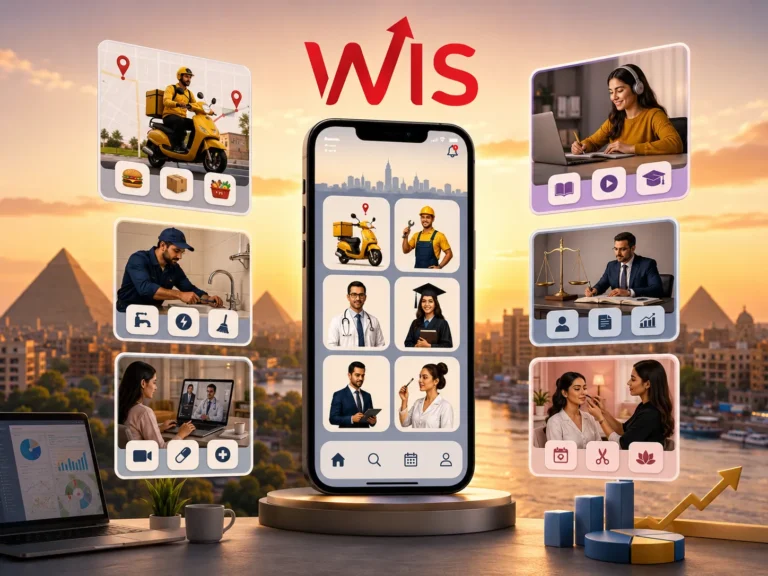
Not all business apps are alike. The app a food delivery company needs is completely different from what a real estate firm, an educational institution, or a distributor network requires.
Choosing the right type of app from the start saves significant time and money and ensures the app serves a clear commercial purpose.
Customer Service App
The most widely used types among businesses are booking, ordering, tracking, and payment. The objective is to reduce friction and make dealing with your company smooth enough that the customer never thinks about switching to a competitor.
Loyalty Programme App
This type focuses less on acquiring new customers and more on retaining existing ones. Instead of traditional discount cards, the app transforms loyalty into an interactive experience, with points for every purchase, exclusive offers, and birthday rewards.
Internal Employee App
Some companies don’t need a customer-facing app at all; they need an app to improve internal operations and workforce management.
Common uses include leave requests, task tracking, internal communication, and document management. The direct result is higher productivity and less time wasted on paper-based processes.
B2B App for Distributors and Partners
If your business works with a network of distributors, agents, or business partners, a B2B app can be one of the best investments available.
The app allows distributors to place orders, track their status, and browse new products, all from their phone. This frees your sales team to focus on closing new deals.
Field Operations Management App
Used in sectors that rely on teams working outside the office, such as maintenance, logistics, and delivery companies.
It enables task assignment to technicians, live location tracking, electronic customer sign-off, and instant invoice generation. The efficiency gains and error reductions are significant.
Educational App (LMS Mobile)
For companies that offer training courses. Content available at any time, assessments, and certificates. It increases the value of your service and strengthens customer loyalty.
Which type is right for your business?
There is no single answer that fits everyone. The choice depends on the nature of your activity, your customers’ behavior, and the objectives you want the app to achieve.
For this reason, every WIS Marketing project begins with a study of the business model and a determination of which app type can deliver the greatest return on investment before any development begins.
A Field Story: How the Right App Saved 40% of Acquisition Costs
One of our clients in the fresh food delivery sector in Cairo had one clear problem: the cost of customer acquisition (CAC) through advertising had reached 250 pounds per customer, and customers would place one order before forgetting the brand entirely.
The problem wasn’t product quality; it was the absence of a tool that connected the customer to the brand after that first order.
At WIS, we didn’t build a full-featured app with every possible function. We built an MVP focused on three features only: reordering past purchases with a single tap, a simple points system, and push notifications for exclusive in-app offers.
The results over six months were clear: customer retention rose by 35%, purchase frequency among app users increased 2.5 times compared to website users, and the blended acquisition cost dropped by 40%.
We then directed the remaining budget toward developing a “smart shopping list” feature built on real user data, the feature that doubled sales. No guesswork, only real data.
Start With an MVP: The Smartest Way to Build a Successful App
Enthusiasm pushes you to want every feature built from day one. That is the perfect recipe for burning through the budget.
Many companies put together a long list of features, begin development, and then discover months later that users don’t actually need half of what was built. This is why successful companies rely on what is known as a Minimum Viable Product, or MVP.
An MVP is not an incomplete version of the app; it is a focused version that concentrates on the core functions users genuinely need and allows the company to test the concept in the market at the lowest possible cost and risk.
What is an MVP?
Simply put, it is the first version of the app containing the minimum number of features capable of solving the user’s core problem. Instead of launching an app with 20 features, you focus on the three or four most important ones, then collect real data from users before investing more time and money.
An MVP saves money in two ways.
Rather than spending 500,000 pounds on a full application, you begin with 200,000 pounds to test the concept.
The data you collect tells you what the market actually wants, so you invest the rest of your budget in the features that are genuinely needed, not the ones you assume are needed.
A practical example: suppose a delivery company wants to launch a new app. Instead of building a complete system with dozens of functions from the start, an MVP is launched containing account creation, service ordering, payment, and order tracking.
User behavior is then monitored and feedback collected before moving to the next phase. This approach significantly reduces risk and conserves a substantial portion of the budget.
How WIS Marketing Applies the MVP Methodology
- Must-have: features without which the app cannot function, including login, product display, and payment. These form the MVP.
- Should-have: important but not required for launch, product reviews.
- Could-have: nice to have but not essential, dark mode.
- Won’t-have: excluded from the current version entirely.
At WIS, we don’t start by asking “how many features do you want to add?” We start with a more important question: what is the minimum number of features capable of achieving the business objective?
Through workshops and user analysis, we define the first version that allows the company to enter the market quickly, then develop the app progressively based on actual results.
Questions You Must Answer Before Signing Any Contract
In many cases, apps don’t fail because of the coding or design; they fail because of the absence of a clear vision from the very beginning. Before requesting any quotes or comparing development companies, make sure you have clear answers to the following questions:
Who is your app’s user, and what is their problem? “An app for everyone” means “an app nobody wants.” Defining a precise segment is the foundation.
What are the three core features of the MVP? Don’t start with everything. Three features that solve the main problem are enough for the first launch.
What is the revenue model? Free and supported by your core business activity, monthly subscription, transaction commission, or in-app purchases? This decision affects every aspect of the app’s design.
What is your budget for development, operations, and marketing combined? The cost of an app doesn’t stop at launch. If your budget only covers development, the app will die shortly after it goes live.
Who will manage the app after launch? Do you have an internal team to analyze data and respond to user queries, or do you need an ongoing maintenance and support contract?
The Cost of Building a Business Mobile App in Egypt 2026
One of the most common questions we hear at WIS Marketing is: how much does it cost to build a business mobile app?”
The short answer is that there is no fixed number. The cost of an app depends on its type, the number of features required, the level of technical complexity, and the extent of integration with other systems.
This is why one company might quote 150,000 pounds for an app while another quotes 600,000 pounds or more for a similar project.
The difference isn’t always in the concept itself; it’s in how it’s executed and what the project actually includes.
Average cost of a business MVP app. In most projects, the cost of developing a professional MVP for businesses in Egypt ranges between 150,000 and 300,000 Egyptian pounds.
This typically includes UI/UX design, app development, a basic admin dashboard, testing, and the initial launch. This is the option we recommend in most cases because it allows the concept to be tested before investing in a larger version.
When do costs increase? The budget grows when the project includes:
- Electronic payment systems
- Live GPS tracking
- Both Android and iOS versions
- ERP or CRM integration
- Advanced loyalty systems
- Real-time messaging
- Artificial intelligence features
- Multiple user types within the same app
Every additional element means more development time, more extensive testing, and greater technical complexity.
Marketing Your App After Launch: The Real Second Half of the Battle
“Build it, and they will come” is the biggest lie in the world of apps. Without a marketing strategy, your app will sit in the graveyard of app stores alongside millions of others.
ASO (App Store Optimization)—70% of downloads come from search within the store. The app name, description, Arabic keywords, and screenshots all directly affect organic downloads. rates. Our specialist team ensures your app appears at the top of results when your ideal customer searches.
Google App Campaigns: for reaching new users across the entire Google network. We define the target audience and the desired cost per install, and the intelligent system handles the rest.
Our experience ensures the lowest possible installation cost and the highest quality of incoming users.
Push Notifications as a retention tool: push notifications are the most powerful feature in any app and also the most dangerous. Overusing them causes immediate deletion.
Our strategy relies on smart, personalized notifications: an abandoned cart, a previously out-of-stock product arriving, and an offer based on past purchases. The goal is value, not irritation.
In-app referral programs, like “Invite a friend and get 10% off for you both,” can generate viral growth at minimal cost. We design and build the most effective referral program for your specific business model.
Why WIS Is the Right Partner for Your Project
The difference between WIS and most app development companies in Egypt and the region isn’t in the code; it’s in the way we think.
- We are a marketing agency first and a development company second.
This means we don’t hand you an app and disappear; we build an integrated strategy with you that ensures your app reaches the right audience and achieves its business objectives.
Phase 1: Understanding the business objectives.
Before any discussion of design or development, we start by understanding the project goals, target audience, revenue model, current challenges, and required success indicators. A successful app starts with understanding the business, not the technology.
Phase 2: Planning and building a smart MVP.
Rather than exhausting the budget by developing dozens of features from the start, we apply the MVP methodology to test the concept with minimum risk and maximum speed to market. We identify only the core functions, then build the first version capable of achieving the project’s business objective.
Phase 3: User experience design.
The UI/UX team designs an easy, seamless experience that helps users reach what they need in as few steps as possible. The goal is not just to make the app look good — it is to make it easy to use and to achieve higher conversion rates.
Phase 4: Development and testing.
The development and QA team builds the app according to best technical practices, testing every component to ensure performance and stability before launch.
Phase 5: Launch and marketing.
This is where most development companies stop. At WIS Marketing, a new phase begins that includes App Store and Google Play optimization, user acquisition campaigns, customer retention strategies, performance analysis, and development of future versions to ensure the app achieves its business objectives after launch, not simply appearing in the stores.
- 15 years of experience in Egypt, the UAE, and the wider Middle East means a deep understanding of local user behavior and market dynamics. No copying of Western models that don’t suit our audience.
- A complete team under one roof: WIS Marketing includes strategists, UI/UX designers, frontend and backend developers, QA testers, ASO specialists, and digital marketing experts. The entire project is executed through one team working toward one goal.
- Full transparency in pricing and execution: a detailed quote, a phased payment structure, and regular performance reports. No surprises along the way.
Frequently Asked Questions
What does it cost to build a business mobile app in Egypt?
An MVP app costs between 150,000 and 300,000 pounds. More complex applications can reach 500,000 pounds and above. It is essential to allocate an additional budget for marketing and operations after launch.
What is an MVP, and why does it save money?
An MVP is the launch of an initial version with only the essential features to test the concept in the real market. It reduces the initial cost and prevents spending on features users don’t actually want.
How do I integrate Paymob or Fawry into my app?
Through the APIs provided by these payment gateways. It requires a developer experienced in working with their specific SDKs to ensure secure and smooth payment processing. WIS has this technical expertise and a documented track record across dozens of projects.
Who manages the app after launch?
You can manage it with an internal team, or through a maintenance and support contract with WIS that covers performance monitoring, security updates, and new feature development.
How long does it take to develop a business mobile app?
It depends on the project size. A simple MVP can be developed within a few weeks, while medium or complex applications may take several months, depending on the number of required functions and technical integrations.
Conclusion
Building a mobile app for businesses is not about having a new listing on the App Store or Google Play. It is about building a tool that helps the company achieve real business objectives.
Successful apps don’t start with design or coding; they start with understanding the user, defining the business objective, choosing the right app type, and then launching a smart MVP that allows the concept to be tested before committing larger budgets.
At WIS Marketing, we don’t just develop the app; we help you launch it, market it, and turn it into a genuine growth engine that supports sales, customer loyalty, and business expansion.
If you are thinking about building an app for your business, get in touch with the WIS Marketing team for an initial consultation and a preliminary study that helps you make the right decision before investing any budget in the project.