
Service app development in Egypt rarely fails because of a weak idea. It fails because many project owners begin coding before understanding how the app will operate and generate revenue. Building a successful service app doesn’t mean creating an app that allows booking alone.
It means building a platform that manages the relationship between the customer and the service provider in real time, covering scheduling, tracking, payment, reviews, and efficient management of service providers.
This is exactly why service apps require careful planning before the first line of code is written.
At WIS Marketing, we have helped companies and entrepreneurs plan and launch service apps in Egypt, the UAE, and the wider Middle East for more than 15 years by identifying the right revenue model, selecting the correct MVP, and avoiding spending on unnecessary features before market testing.
In this guide, we cover the most in-demand types of service apps in Egypt, the essential technical features, local market challenges, and expected development costs for building a successful service app in 2026.
How to Start Service App Development in Egypt the Right Way
Developing a successful service app in Egypt requires planning the business model first, then defining the essential features, choosing the right technology, and building a testable MVP before investing in a fully integrated platform.
The most important components of service apps include the booking system, service provider management, order tracking, electronic payment, reviews, and operational dashboards.
At WIS Marketing, we help companies and entrepreneurs develop scalable service apps by combining product strategy, technical execution, and long-term commercial planning.
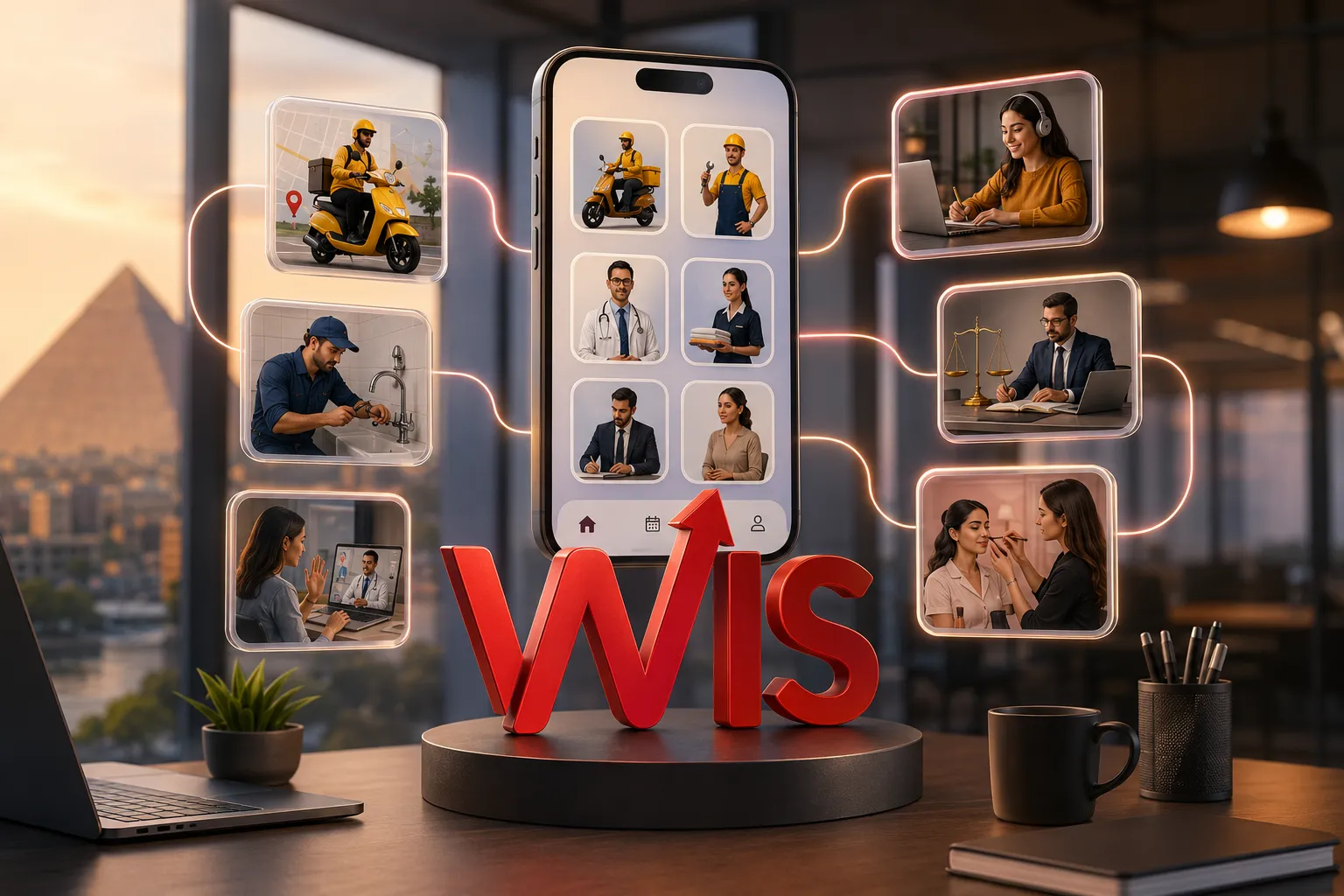
The Most In-Demand Types of Service Apps in Egypt 2026
The expected annual growth rate for the on-demand services sector in Egypt exceeds 18%, with a projected market size reaching 4 billion dollars by 2026. But not every sector carries the same opportunity and challenge level.
Each sector has different requirements in terms of user experience, operating model, and revenue generation mechanisms.
Delivery and order apps are the most widespread and the most competitive. The customer acquisition cost (CAC) in Cairo reaches around 7 dollars, but the customer lifetime value (LTV) exceeds 150 dollars if retention is managed well.
The real competition here is in speed and user experience.
Home services apps represent a massive and unorganized market, and that is where the real opportunity lies.
Plumbers, electricians, cleaners. Millions of Egyptians need these services daily without any reliable way to access them.
Healthcare apps operate in a sensitive sector that demands the highest levels of trust and security. Video consultations and medication delivery are experiencing exceptional growth.
The cost per click (CPC) on Google in this sector ranges between 0.45 and 1.10 dollars, which requires carefully optimized campaigns.
Education and training apps are dominated by the subscription model. WIS Marketing helped one educational platform increase its subscriptions by 300% through targeted campaigns and search engine optimization.
Professional services apps covering lawyers, accountants, and consultants rely more on credibility and qualification verification as the key to success, even more than technical features.
Beauty and personal care apps for booking hair, makeup, and spa appointments at home are seeing strong demand in Cairo and Alexandria, driven by a growing middle class looking for convenience.
The Features That Make a Successful Service App, and Those That Waste Your Budget
A service app’s success doesn’t depend on the number of features it contains. It depends on choosing the features that help users complete a service easily and enable business owners to manage operations efficiently.
In most cases, the following features are non-negotiable essentials for any professional service app.
Features You Cannot Do Without
- A booking and scheduling system that reflects real availability
Not a static calendar, but a dynamic system that updates in real time with every service provider’s schedule. Double bookings destroy trust in an instant.
- Real-time GPS tracking
“The technician is five minutes away” has become a baseline expectation, not an added feature. In Egypt, GPS accuracy can be unreliable in some areas, so we recommend integrating multiple map APIs alongside a manual location selection option.
- An escrow payment system
When a customer books a service, the payment amount is held in an intermediary account and is transferred to the service provider only after completion is confirmed. This builds genuine trust and protects both parties, and it is the difference between a platform people use and one they avoid.
- In-app chat
For coordination, sending photos of the problem, and confirming details. It keeps all communication within the platform and makes dispute resolution significantly easier.
- A two-way rating system
The customer rates the service provider, and the service provider rates the customer. This builds a healthy community and encourages professional behavior from both sides.
- A service provider dashboard with a KYC system
A central place for uploading documents, verifying identity, and confirming experience. This dashboard is your first line of defense for ensuring the quality of your provider network.
Smart notifications at every stage. “Your request has been accepted,” “the technician is on the way,” “don’t forget to leave a review.” Every notification must add value, not noise.
Features That Waste Your Budget at the Start
Complex matching algorithms, a fully developed loyalty system, advanced data analytics, and multi-language support are all genuinely valuable features, but they belong to the growth stage, not the launch stage. Starting with them doubles the cost and delays reaching the market.
What Does It Cost to Develop a Service App in Egypt in 2026?
There is no fixed cost for developing a service app in Egypt, because the final price depends on the nature of the project, the expected number of users, the level of technical complexity, and the features required in the first version of the app.
In most projects, planning begins with building an MVP that includes core functions such as registration, booking, payment, notifications, and service provider management, with the goal of testing the market and gathering user feedback before investing in a fully integrated platform.
What drives up the cost unnecessarily? A long wish list of features that aren’t needed at the start.
Key Factors That Affect Service App Development Cost
App type: a simple home services app differs in cost from a platform hosting hundreds of service providers or an app that relies on live tracking, video consultations, or smart matching algorithms.
Number of platforms required: Will the app be developed for iOS and Android only, or will there also be a management dashboard, a service provider panel, and possibly a web portal for customers?
Technical features: features such as real-time location tracking, electronic payment, in-app messaging, rating systems, and identity verification all directly affect the project’s scope and the time required for development.
Project stage: building a testable MVP helps companies reduce risk and verify real market demand before moving to investment in a more advanced platform.
At WIS Marketing, we always recommend starting with a well-considered MVP, then developing the app progressively based on real usage data, which helps companies manage their budget efficiently, speed up time to market, and reduce the likelihood of building features users don’t need in the early stages.
Estimated Cost and Timeline
|
App Type |
Estimated Cost |
Timeline |
|
MVP for a single service |
$8,000 to $15,000 |
3 to 4 months |
|
Multi-service platform |
$15,000 to $25,000 |
4 to 6 months |
|
Full On-Demand (GPS, Chat, Escrow) |
$25,000+ |
6+ months |
How WIS Marketing Works: Service App Development Stages from Idea to Launch
At WIS Marketing, we don’t treat service app development as a software project that starts with code and ends with publishing on the stores. We treat it as an integrated process aimed at building a digital product capable of growth and revenue generation over the long term.
Stage 1: Business model study
We start by understanding the project idea, defining how the app will operate, analyzing the customer and service provider journey, and selecting the appropriate revenue model, whether it relies on commissions, subscriptions, or fixed fees per request.
Stage 2: Defining the MVP scope
Rather than developing dozens of features from day one, we help clients identify the core functions that allow market testing and launching a usable initial version while minimizing costs and accelerating access to users.
Stage 3: User experience design
The design team builds a user experience that helps customers request services easily and enables service providers to manage their schedules and requests efficiently, with a focus on reducing booking steps and improving conversion rates.
Stage 4: Development and testing
The app is developed according to a clear plan that includes technical testing, performance testing, and user experience testing to ensure a stable product is launched that can handle the expected growth.
Stage 5: Launch and continuous improvement
After the app is published, we continue monitoring performance, analyzing user behavior, and adding improvements and new features based on real usage data to ensure the service app can scale and achieve its business objectives over the long term.
At WIS Marketing, we believe successful service apps are not built all at once. They are developed progressively based on market needs, which helps companies reduce risk, improve return on investment, and launch digital products that are more competitive.
Why Choose WIS Marketing for Service App Development in Egypt?
The fundamental difference between WIS and any other development company in the market is that we don’t start with coding.
We start with market analysis and understanding the problem your app solves. Then we build the product strategy that defines which features are necessary and which ones can wait.
Then we coordinate with the development team to ensure execution that understands the specific nature of service apps, not retail apps.
We start with product strategy, not programming
Before designing any screen or writing any code, we study the business model, define the operating mechanism, select the revenue model, and prioritize features to ensure we build a product that can be tested and scaled.
We help you launch a smart MVP that saves time and budget.
Rather than investing a large budget in developing dozens of features from day one, we help you identify the minimum functions that allow market testing, gathering user feedback, and making decisions based on real data.
A specialist team covering every project stage.
We understand how a customer thinks when searching for a service and how a service provider thinks when looking to increase their income. This dual understanding shows in every design decision.
The WIS Marketing team includes specialists in UI/UX, app development, backend engineering, quality assurance, and project management, ensuring the project is executed according to a clear plan and consistent quality standards.
Experience in the Egyptian market and local user needs
We have experience with the challenges specific to service apps in Egypt, including local payment systems, user behavior, and service provider operating mechanisms, which helps build solutions that are better suited to the target market.
A long-term partnership after launch
Our role doesn’t end when the app is published on the stores. We continue monitoring performance, analyzing user behavior, improving the product, and adding new features that help companies grow and achieve a greater return on investment.
At WIS Marketing, we believe a successful app is not just an app that launches. It is an app that can continue attracting users, improving customer experience, and supporting business growth for years ahead.
Frequently Asked Questions
What features are essential for a service app?
A booking and scheduling system that reflects real availability, GPS tracking, an Escrow payment system, in-app chat, two-way ratings, and a service provider dashboard with a KYC system.
How much does developing an On-Demand app in Egypt cost?
An MVP for a single service starts from $8,000. A multi-service platform ranges from $15,000 to $25,000. A full-featured app starts at $25,000 and above. The exact figure depends on the features and the project stage.
How long does it take to develop a professional service app?
It depends on the project size, but most service apps require several stages covering planning, user experience design, development, testing, and launch. The MVP methodology helps reduce time to market.
What is the best technology for developing a service app?
The choice depends on the nature of the project and future expansion plans. In some cases, Flutter is a suitable choice for reducing cost and speeding up development, while Native solutions may be more appropriate for projects with specific performance requirements.
Does WIS Marketing provide maintenance and development services after launch?
Yes. We provide maintenance, periodic updates, user experience improvements, and new feature additions to help companies develop their apps continuously and achieve long-term growth.
Conclusion
Successful service apps are not built simply because they have a good idea. They are built because they start with a clear operating plan, a well-considered revenue model, a user experience that brings customers back, and an infrastructure that enables service providers to work efficiently.
For this reason, the decision to develop a service app in Egypt is not just about choosing a software company. It’s about choosing a partner who helps you make the right decisions before investing time and budget in development.
At WIS Marketing, we help companies and entrepreneurs plan and build scalable service apps, from studying the business model and defining the right MVP, through user experience design, to launch and continuous development, to ensure a digital product is built that can compete and generate a real return on investment.
If you are thinking about launching a new service app or have an idea that needs technical and commercial evaluation, you can get in touch with the WIS Marketing team for an initial consultation and discuss the best way to turn your idea into a scalable digital product without spending your budget on development that the market may not need in its early stages.