
In a market as saturated with advertising as Cairo, the challenge is no longer producing a “good” ad; it’s making sure that ad reaches the right person, at the right time, with enough repetition to create real impact.
What many business owners fail to notice is that TV ads rarely fail because of a weak concept or poor production quality. They fail because of poor broadcast planning. An ad you spend hundreds of thousands, or millions, on can pass by completely unnoticed by your target audience simply because it aired at the wrong time or on a channel your customers don’t watch.
This is where the real role of a TV advertising agency in Cairo comes in. Not just an entity that executes your ad, but a partner that determines how, where, and when it appears and how it transforms from a marketing cost into a tool that delivers measurable results.
In this guide, you’ll learn what a TV advertising agency actually does, the difference between a production company, a media planning agency, and a full-service agency, the key criteria that separate a professional agency from intermediaries, and how to choose an agency capable of generating the highest return from your budget.
Because success on television doesn’t only depend on what you say; it depends on who sees it, when they see it, and how many times they see it.
What Does a Full-Service TV Advertising Agency Actually Offer?
Before searching for an agency, you need to understand the difference between three distinct entities that many advertisers in the Egyptian market confuse, because that confusion alone is responsible for wasting millions of pounds annually.
The Difference Between a Production Company, a Media Planning Agency, and a Full-Service Agency
|
Production Company |
Media Planning Agency |
Full-Service Agency |
|
|
What it does |
Films and produces the ad |
Plans and buys airtime |
Both under one strategy |
|
What it doesn’t do |
Doesn’t plan or buy airtime |
Doesn’t create content |
— |
|
Core strength |
Image and sound quality |
Maximum reach at lowest cost |
Creative-to-broadcast alignment |
|
Risk of using alone |
A good ad no one sees at the right time |
Strong broadcast for a weak ad |
No risk, covers all stages |
|
Best for |
Those with an in-house media team |
Those with a ready ad to distribute |
Those launching a campaign from scratch |
Full-Service vs. Specialist Agency
A specialist agency may excel in one area, but the separation of production from distribution in Egyptian television carries a real hidden cost. When the creative team and the media planning team work in the same place, ideas come out executable within the actual available budget, not perfect on paper, only to collide with financial reality later.
The revisions that happen between two separate teams add an average of 15 to 20% to the campaign’s total costs.
When Do You Need a Full-Service Agency vs. Just a Production Company?
|
Situation |
Best Option |
|
You have an experienced in-house media team |
Production company only |
|
You have a ready ad and want smart distribution |
Media planning agency only |
|
You’re launching a campaign from scratch |
Full-service agency |
|
You’re targeting Ramadan or a major competitive season |
Full-service agency, no exceptions |
|
Your budget is limited, and you want maximum return |
Full-service agency, coordination saves, not costs |
Dealing directly with channels like ON, DMC, and CBC without an experienced intermediary means paying the published rate card. An agency with direct relationships gets Agency Rates, Bonus Spots, and priority in peak periods, advantages that a direct client simply cannot access.
8 Criteria for Choosing a Professional TV Advertising Agency in Cairo
These criteria aren’t a theoretical checklist; they’re practical evaluation tools that let you filter agencies before signing a contract or paying a deposit.
1 — A Real Showreel That Meets Broadcast Standards
Social media videos don’t prove TV production capability. Broadcast standards are fundamentally different; resolution, audio processing, and color ratios all differ significantly between digital platforms and television broadcasting.
What to ask for specifically: a list of ads that actually aired on Egyptian channels, with channel names and broadcast dates; measurable results from past campaigns, not just attractive visuals; and direct contact with a past client in a sector similar to yours.
Warning sign: an agency presenting a showreel with no mention of channels or performance indicators is almost certainly working at the digital level, not television.
2 — Direct Relationships with Channels, Not Middlemen Upon Middleman
Some agencies don’t have direct accounts with channels; they work as intermediaries, passing your request to another agency while adding their own margin. This means you pay more and get lower priority for good time slots.
The direct question to ask: “Do you have a direct account with United Media Services?” Which channels do you work with directly?”
|
Type of Relationship |
Cost Impact |
Priority Impact |
|
Direct channel relationship |
Agency Rates 15–20% lower |
Priority in peak periods |
|
Second-tier intermediary |
Added margin on top of the rate card |
No priority, leftover slots only |
|
Third-tier intermediary |
Very high cost |
Marginal airtime only |
3 — Creative, Production, and Media Planning Teams Under One Roof
When the creative team works in isolation from the media team, ideas emerge that are perfect on paper but collide with broadcast budget realities or timing constraints later, leading to costly, delayed revisions.
A real example: an agency produced a 60-second ad without coordinating with the media team, only to discover the client’s budget only covered 30-second slots.
Re-editing took 3 additional weeks and caused the loss of pre-booked airtime. Internal coordination between the two teams saves an average of 15 to 20% of total campaign costs.
4 — Documented Experience in Your Specific Sector
Every sector has a different purchase journey, and therefore a different broadcast strategy.
|
Sector |
Target Audience |
Best Airtime |
Ideal Ad Length |
|
FMCG and food |
Homemakers |
12–3 PM and 8–11 PM |
30 seconds |
|
Real estate |
Decision-makers 35–55 |
9–12 PM |
45–60 seconds |
|
Financial services |
Employees and business owners |
7–9 AM and 9–11 PM |
30 seconds |
|
Education and schools |
Mothers |
2–5 PM |
30–45 seconds |
The revealing question: “What airtime slots achieved the highest conversion rate in a sector similar to mine?” An agency with real data will answer with numbers. One who guesses will answer with generalities.
5 — Full Transparency in Broadcast Costs and Commissions
Agencies that bundle airtime costs with agency fees into a single number are usually hiding high profit margins or additional channel commissions.
What must be itemized in the contract:
|
Item |
What It Must Include |
|
Airtime cost |
Completely separate from agency fees |
|
Agency fee |
A clear percentage or fixed number |
|
Log Sheets |
Official channel reports confirming when the ad aired and for how long |
|
Bonus Spots |
Clarification of the agreed free additional slots |
An agency that avoids itemizing these elements is telling you something important about how it operates.
6 — A Real Ability to Measure Performance with Clear Indicators
TV advertising is no longer immeasurable. A professional agency presents real performance indicators, not just “people are talking about the ad.”
The indicators you should ask for:
GRP — Gross Rating Points: measures the total of viewership ratings across all ad broadcasts. GRP = Reach% × Average Frequency. The higher the number, the greater the total exposure.
Reach: the percentage of the target audience that saw the ad at least once.
Frequency: the average number of times each member of the audience saw the ad. The ideal frequency in the Egyptian market is between 3 and 5 times for effective memory building.
Brand Lift: the increase in brand name searches on Google during the campaign period, a measurable indicator that connects television to digital response.
7 — Flexibility Across Budgets and Ability to Deliver Results on Mid-Range Budgets
Egyptian television isn’t exclusive to large companies. Specialized and regional channels provide effective access to specific audiences at costs starting in the hundreds of thousands, not millions.
A real example: a mid-sized food brand booked airtime on a specialized cooking channel at 300,000 EGP per month and achieved higher reach among its target audience than a campaign on a major channel at a million pounds because the specialized channel speaks directly to its viewers.
The revealing question: “What’s the smallest budget you’ve worked with and still achieved measurable results?” A good agency will give you a real example with actual numbers.
8 — Discipline Around Final Deadlines
A single day’s delay in delivering materials to a channel during Ramadan means losing pre-booked slots, a direct financial loss with no compensation.
What to verify: Does the agency have a documented track record of meeting channel deadlines? Is there a clear compensation clause in the contract for delays on the agency’s side? Do they have specific experience in Ramadan, the most high-pressure season in the Egyptian ad market?
Summary Table: The 8 Criteria and How to Test Each
|
Criteria |
Revealing Question |
A Good Agency’s Answer |
|
Showreel |
Which channels have your ads actually aired on? |
Specific channel names and broadcast dates |
|
Channel relationships |
Do you have a direct account with United Media Services? |
Yes, with account details |
|
Team integration |
Who communicates with whom internally? |
One integrated team, not separate departments |
|
Sector experience |
What’s the best airtime for my sector? |
Answer with data, not generalities |
|
Transparency |
Can you separate airtime costs from agency fees? |
Yes, with official Log Sheets |
|
Performance measurement |
How do you measure GRP and Reach? |
Specific tools and regular reports |
|
Flexibility |
What’s the smallest budget you’ve achieved results with? |
Real example with actual numbers |
|
Discipline |
What happens if delivery is delayed? |
Clear compensation clause in the contract |
The Services a Full-Service TV Advertising Agency Must Provide
The common mistake is treating a TV ad as a “video to be filmed,” when in reality it’s an integrated system that starts before the camera rolls and ends after the broadcast.
1 — Strategic Planning and Media Planning
Media planning isn’t a broadcast schedule; it’s the decision that determines who sees your ad, when, and how many times. It begins with a precise analysis of your target audience’s viewing behavior: which channels do they watch, at what times, and what type of content precedes and follows your ad?
Market data indicates that poor planning wastes up to 40% of TV broadcast budgets in Egypt, because ads air during periods when the target audience simply isn’t there.
Professional media planning outputs:
|
Output |
What It Means in Practice |
|
Channel map |
Optimal channels for your audience with data justification |
|
Broadcast schedule |
Optimal time slots for each channel |
|
Budget distribution |
Spending allocation per channel and period |
|
GRP and Reach targets |
Measurable target figures |
2 — Creative Development and Concept
The creative brief is the most important document in the campaign; it defines the single message the viewer must leave with. A professional agency doesn’t begin writing before understanding three things deeply: what actually drives your customer to buy, what stops them, and what message turns that barrier into a motivation.
The hook in the first 3 seconds is the difference between a viewer who stays and one who changes the channel. This isn’t an exaggeration; it’s a reality confirmed by Egyptian viewing behavior, where the viewer has dozens of channels at the press of a button.
Example of the difference: “Our product is the best in the market,” a message the brain instantly ignores because it’s expected. “For the first time in Egypt, a taste you never imagined,” a message that arouses curiosity and forces attention.
3 — Full Production from Filming Through Post-Production
Production from a full-service agency differs from a standalone production company in one fundamental way: every production decision is made in light of the media plan.
Ad length, pacing, and message tone are all shaped based on the target channel and time slot.
|
Production Element |
Professional Standard in 2026 |
Consequence of Neglect |
|
Image resolution |
4K minimum |
Blurry image on modern HD screens |
|
Audio recording |
Separate from the filming environment |
Background noise that immediately signals amateur work |
|
Color correction |
Professional color grading |
“Home video” appearance, regardless of the camera used |
|
Delivery specs |
Customized per channel |
Ad rejected or appearing distorted |
4 — Media Buying and Channel Negotiation
This service represents the largest financial difference between working with a full-service agency and dealing directly with a channel.
An agency buying large advertising blocks for multiple clients gets Agency Rates, discounted prices unavailable to direct clients. They also negotiate Bonus Spots, free additional airtime added on top of the base agreement, and Off-peak rates to increase frequency without increasing the budget.
A practical example: a client buying directly from a channel gets 100 seconds of airtime for 500,000 EGP. The same budget through an agency with a direct relationship: 130 to 140 seconds after Agency Rates and Bonus Spots. The difference: 30 to 40% more airtime for the same budget.
5 — Post-Broadcast Monitoring, Measurement, and Performance Reports
The campaign doesn’t end on the first broadcast day; continuous improvement begins. A professional agency monitors every channel’s performance and every time slot weekly, then redistributes the budget based on actual results.
What weekly performance reports must include:
|
Indicator |
What It Measures |
Why It Matters |
|
Achieved vs. target GRP |
Actual performance vs. plan |
Reveals whether the plan is on track |
|
Reach % |
Percentage of the target audience who saw the ad |
Measures actual penetration |
|
Frequency |
Average views per individual |
Ensures sufficient repetition for recall |
|
Branded Search Lift |
Rise in brand-name Google searches |
Connects TV to digital response |
|
Log Sheets |
Official channel documentation of each broadcast |
Proves what was paid for actually aired |
The most important decision in this phase is budget reallocation; if data shows a particular channel isn’t achieving its target GRP, its budget moves immediately to a better-performing channel.
This flexibility in redistribution is what separates a campaign that improves over time from one that simply runs its course regardless of results.
Questions That Reveal an Agency’s Professionalism Before You Sign
A good agency doesn’t fear tough questions; it welcomes them with confidence and answers with numbers and real examples, not generalities.
|
Question |
A Good Agency’s Answer |
Warning Sign |
|
How do you select the right channels for my audience? |
Specific viewership data for your age and geographic segment |
“We know which channels work” with no data |
|
What’s your commission, and how is it calculated? |
A specific number or percentage, separate from airtime |
“The price is all-inclusive.” |
|
Is your production team internal or outsourced? |
A clear answer with an explanation of the cost and timeline impact |
Evasion, or “it depends on the project.” |
|
How do you handle an airtime error? |
Clear protocol and a real past example |
“This never happens with us.” |
|
Can I speak with a past client in my sector? |
Yes, immediately, with name and contact |
Delay or apology |
|
What’s my campaign’s target GR, P, and how did you calculate it? |
A specific number based on viewership data in your sector |
“We’ll achieve maximum reach possible.” |
|
What happens if the campaign doesn’t hit the agreed GRP? |
Compensation mechanism or budget redistribution documented in the contract |
“TV can’t be 100% guaranteed” with no alternative |
|
How many projects are you running during my campaign season? |
Clear number with confirmation of available capacity |
Evasion or “we have a big team.” |
3 Additional Questions Specifically for Ramadan:
“When do you start booking airtime for Ramadan?” The right answer: 3 to 4 months before the month begins. An agency that starts booking in January for a March Ramadan is working too late and will get whatever slots remain.
“Do you have previous Ramadan experience in a sector similar to mine?” The right answer: a real example with numbers, not “yes, we have extensive Ramadan experience.”
“What’s the price difference between Ramadan prime time and other periods?” The right answer: a specific percentage, typically between 200 and 400% above the normal rate. An agency that doesn’t know this number precisely has never worked Ramadan seriously.
Warning Signs: Agencies to Walk Away From Before You Pay
“We’ll guarantee you the top viewership rating.”
There are no guarantees in television. Viewership figures are affected by dozens of factors outside any agency’s control: competing programming, current events, and shifting viewing behavior.
An agency that guarantees specific results either doesn’t understand the market or is making promises it has no intention of keeping. A good agency offers “data-based projections” within a realistic range, not guarantees.
“We don’t need a media plan; we know the channels.”
This means the agency relies on personal experience and habit rather than actual viewership data analysis for your target audience.
In a TV market where viewing behavior constantly shifts, operating on “we know the channels” without a media plan means wasting up to 40% of the broadcast budget on periods when your audience isn’t there.
“The price is all-inclusive and can’t be itemized.”
A total figure without a breakdown usually hides high profit margins or double commissions from channels. An agency that refuses to separate airtime cost from agency fees from production cost is positioning itself to avoid accountability, and that’s not an accident.
Absence of Log Sheets or Refusal to Provide Them:
Log Sheets are the official channel documents proving when your ad aired, on which channel, and for how long. An agency that refuses to provide them or delays sending them is hiding one of two things: either the ad didn’t air in the agreed slots, or the slots were of lower value than what was paid for.
Log Sheets are a fundamental advertiser right, not an additional service you request politely.
No Documented TV Work in the Showreel
An agency presenting only social media videos in its showreel operates in a completely different market from television. Broadcast standards are technically different, and an agency that hasn’t produced ads actually aired on Egyptian channels doesn’t have the experience needed to navigate those standards.
Promises of Results Within a Week or Two:
Building brand awareness through television requires sufficient repetition to settle in the viewer’s memory. A campaign promising immediate results in a week either overpromises or lacks understanding of how TV advertising actually works.
The realistic benchmark in the Egyptian market: Brand Lift starts becoming measurable after 4 to 6 weeks of consistent broadcast.
Works with “Everyone” Without Sector Specialization An agency claiming to work in real estate, food, education, cars, and pharmaceuticals simultaneously, without a specialized team for each, lacks the necessary depth in any of them.
Sector specialization isn’t a luxury; it’s what gives an agency a genuine understanding of your customers’ purchase journey and viewing behavior.
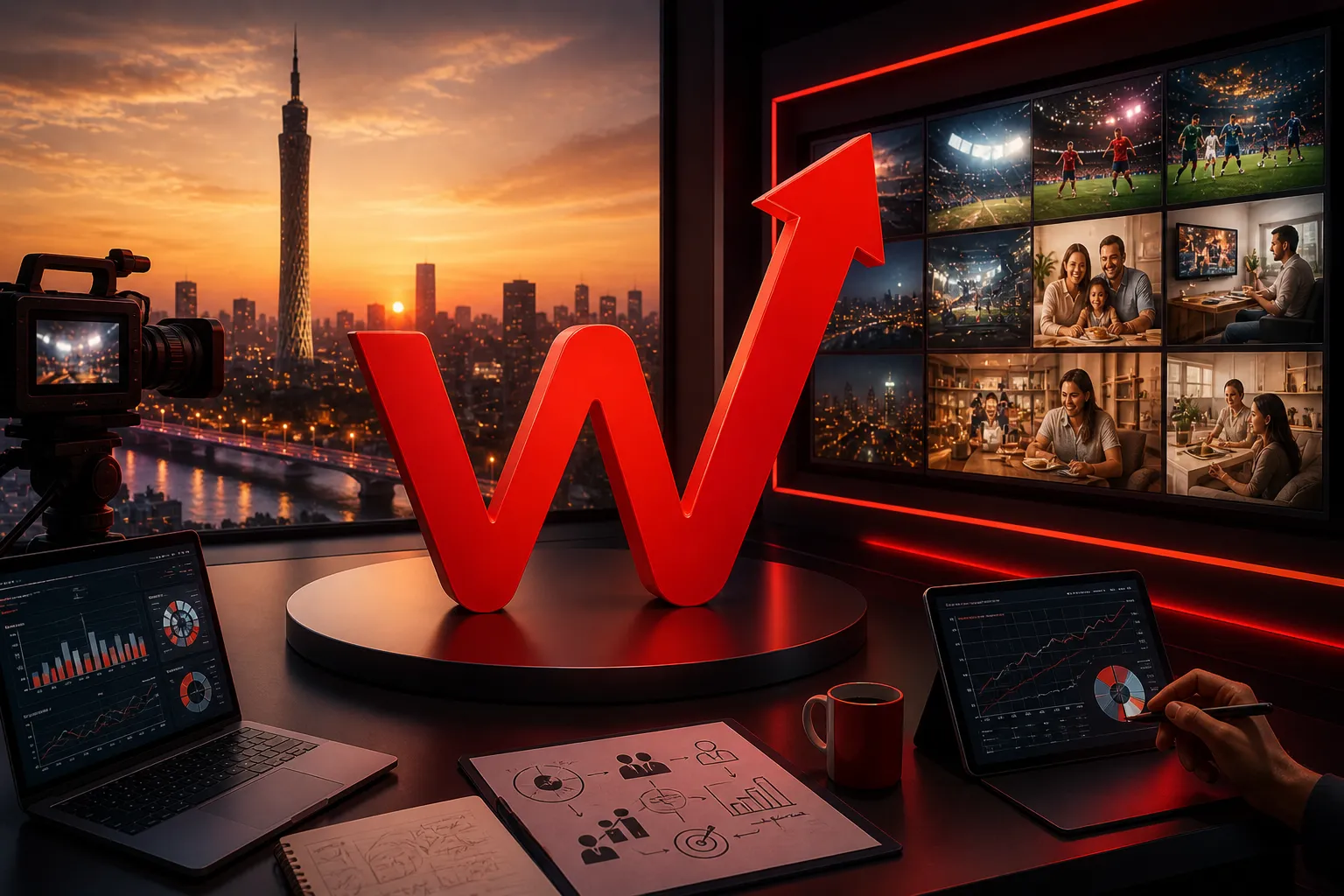
WIS Marketing: How We Operate as a Full-Service TV Advertising Agency in Cairo
A real example from the market: a food brand started with a limited budget on a regional channel. Instead of distributing the budget randomly, the focus was on specific viewing periods around football matches, smart repetition within the same time block, and connecting airtime to target audience behavior.
Results within just two months: orders increased by 300%, and the business expanded noticeably in Cairo. The ad didn’t change, but the way it was run made all the difference.
End-to-End Service: From Strategy to Results
A full-service agency doesn’t execute part of the process; it manages all of it: market and audience analysis, concept and message development, ad production, broadcast planning, airtime buying, performance monitoring, and plan adjustment.
For you as a business owner, instead of dealing with multiple parties, conflicting decisions, and wasted time and budget, you get one clear vision, one accountable party, and results that can be measured and improved.
Frequently Asked Questions
What’s the difference between an advertising agency and a production company?
A production company executes the ad, camera, lighting, and editing. A full-service advertising agency sets the strategy, develops the creative concept, produces the ad, buys airtime at Agency Rates, and measures performance after broadcast.
Using only a production company gives you a good ad that your target audience may never see at the right time.
How much does a TV ad cost in Egypt in 2026?
The cost splits into two parts that must never be confused: production cost and broadcast cost. Production starts at 150,000 EGP for mid-range ads and reaches millions for mega-brand campaigns. Broadcasts start from tens of thousands monthly on specialized channels and reach millions on major channels during Ramadan.
The common mistake is allocating most of the budget to production while neglecting broadcast, or the reverse.
Does the agency actually negotiate channel prices?
Yes, but not all agencies have the same capability. An agency with direct channel accounts buying large advertising blocks gets Agency Rates 15 to 25% below the official rate card, plus Bonus Spots and priority in peak periods.
An agency operating as an intermediary adds its own margin on top of the official rate, which is the opposite of what should happen.
When should I start planning a Ramadan campaign?
At a minimum of 3 to 4 months before the month begins. Premium spots on major channels are booked in October and November for the following Ramadan. An agency that starts booking in January for a March Ramadan will mostly get what’s left, not the highest-value slots.
How do I measure my TV campaign’s success?
Four main indicators: GRP — total rating points measuring cumulative ad exposure. Reach, the percentage of your target audience that saw the ad at least once. Brand Lift is the rise in your brand name searches on Google during the campaign.
And Log Sheets, the official channel documents proving when your ad actually aired.
What’s the minimum campaign duration for real results?
One month is insufficient for building cumulative awareness. The realistic standard is 3 consecutive months to achieve enough frequency for viewers to remember your brand. Campaigns lasting 6 months or more achieve noticeably higher Brand Recall because repetition is the mechanism of memory consolidation.
What’s the difference between Prime Time and Off-Peak, and how do I use both?
Prime Time is 8 PM to midnight, the highest viewership, and the highest cost. Off-Peak is mornings and afternoons, 40 to 60% lower cost with lower viewership. The smart strategy combines both: Prime Time for initial awareness building and Off-Peak to increase frequency at lower cost.
Conclusion
In a market like Egypt, where competition for viewer attention is fierce and choices are endless, producing a good ad is not enough. The ad that actually succeeds is planned, run, and measured with precision. Every step, from choosing the channel to timing the broadcast to determining frequency, either moves you closer to real results or drains your budget without impact.
The difference between a campaign that only achieves reach and one that drives sales isn’t only in image quality; it’s in who manages the campaign and how it’s managed. An agency that understands the Egyptian market, holds real measurement tools, and connects creativity to data is what transforms advertising from a cost into an investment.
If you’re thinking about launching a TV advertising campaign in Cairo, the first step isn’t choosing a channel; it’s choosing the right partner. Get in touch with the WIS Marketing team for a free analysis of your current situation, a competitive study, and a comprehensive media plan built on Egyptian market data, one focused not just on exposure but on delivering measurable results.