
In a market flooded with advertising, the challenge is no longer simply being seen; it’s being seen in the right place, in front of the right audience, at the right moment.
And that’s where the real problem starts.
Most companies treat road advertising as nothing more than booking space. They pick a location based on price or reputation, without genuinely evaluating the viewing angle, the nature of passing traffic, or whether the permits are even valid. The result: a billboard in a spot no one properly sees, and a budget that disappears without a trace.
A professional road billboard company doesn’t sell you space; it builds you a strategic impact point anchored in four non-negotiable factors: traffic volume, audience profile, viewing angle, and campaign objective.
This guide gives you everything you need to make a sound investment decision: how to choose a road billboard company in Egypt the right way; the 7 criteria that reveal any company’s quality before you sign; the best locations and advertising corridors; 2026 price ranges; and how to avoid the mistakes that quietly drain budgets without delivering results.
Because success in road advertising doesn’t come from having an ad, it comes from choosing the right location, the right company, and the right strategy.
Why Choosing a Specialized Road Billboard Company Is Different from a General Agency
The difference between the two doesn’t show up in the pitch deck; it shows up the moment you need pricing flexibility, fast execution, or a legal guarantee that your ad will stay up for the full contract period.
Owned Location Networks: The Real Differentiator
A general agency typically operates as a middleman, buying locations from other companies and reselling them to you at a higher margin. This means you pay more, get less flexibility, and lose negotiating power during peak seasons.
A specialized road billboard company, by contrast, owns its locations outright, manages its own permits, and controls availability and timing. The result is faster execution, genuine pricing flexibility, and in some cases cost reductions of up to 30%.
More importantly, owning the locations means campaign continuity; you won’t be surprised by your board being removed or relocated due to disputes between third parties.
Highway Experience ≠ Street-Level Experience
This distinction is overlooked by many advertisers, and it’s one of the most common causes of wasted budget.
Advertising on the Alexandria Desert Road or the Suez Road operates in a completely different environment from advertising in Mohandessin or Nasr City. On highways where speeds exceed 100 km/h, a driver has just 3 seconds to see and absorb your ad, which imposes strict constraints on design, message, and size.
On inner-city streets where congestion slows traffic, viewing time increases and design possibilities expand.
A specialized company understands the difference between a “quick-glance billboard” that relies on a single message and a single image and a “long-view billboard” that allows for more detail and richer visual elements.
Confusing the two doesn’t just mean weak performance; it means spending an entire budget on an ad that never actually lands.
Permits and Regulatory Relationships: The Most Overlooked Factor
Egypt’s outdoor advertising regulatory environment has tightened considerably in recent years. Authorities such as the National Roads Company and local municipalities impose strict requirements, including engineering and security approvals and periodic permit renewals.
A company with active permits and direct working relationships with these authorities gives you something that doesn’t appear in any pitch deck: real legal security. The Egyptian market has seen multiple cases of large campaigns removed within 48 hours due to permit issues, resulting in a complete loss of the paid budget with no compensation.
When you contract with a specialized company with a clean legal record, you’re not just paying for steel and vinyl. You’re paying for a guarantee that your ad stays up for the full contract period.
7 Criteria for Choosing the Best Road Billboard Company in Egypt
1 — Breadth and Geographic Coverage of the Location Network
A company with only 5 billboards can offer nothing more than a single appearance in a single location. A company with a wide network gives you something fundamentally different: the ability to build an “advertising sequence” where a driver sees your ad more than once on the same journey across different corridors.
This visual repetition isn’t a luxury; it’s the mechanism that transforms a passing impression into cumulative brand awareness. Confirm that the company holds locations on major corridors, including the Ring Road, Al Shaheed Axis, and Suez Road, and across both new and established cities.
2 — Materials and Print Quality
Egypt’s sun exposes print quality with unforgiving speed. Cheap inks fade within weeks, and substandard materials crack or tear before the contract period ends. When a driver sees a faded or damaged ad, the impression that forms in their mind isn’t about the billboard company; it’s about your brand.
The specifications to ask about are materials of at least 13 oz weight, UV-resistant printing, and uniform backlighting that ensures color clarity at night from a minimum distance of 500 meters.
3 — A Documented Track Record with Recognizable Clients and Inspectable Locations
Major clients in real estate, food, and banking don’t work with advertising companies without prior due diligence. Their names appearing in a company’s portfolio is a credibility signal that’s difficult to fabricate.
But don’t stop at names. Request a digital map of the company’s actual locations, and go inspect some of them yourself before signing. During the inspection, focus on one thing: does the location face traffic directly at a comfortable viewing angle, or is there a deviation that would require drivers to turn unnaturally to see it? That question alone reveals a great deal.
4 — Price and Contract Transparency with No Hidden Fees
The all-inclusive price should cover location rental, printing, installation, permits, and ongoing maintenance. Any company that presents a base price, then adds separate charges for replacing lighting or repairing wind damage, is telling you something important about how it operates.
A professional contract clearly specifies the guaranteed display period, compensation procedures if the board is damaged or removed for reasons beyond the advertiser’s control, and maintenance protocols with a guaranteed response time.
5 — Maintenance and Follow-Up Throughout the Campaign
A neglected billboard doesn’t just mean wasted budget; it means direct negative advertising for your brand. A burned-out light for two consecutive nights means losing approximately 15% of your total nighttime reach. A wind-torn design means everyone passing that location sees a negative image of your company.
The standard to agree on explicitly in the contract: the company’s commitment to repair within 24 hours maximum from the moment any fault or damage is reported.
6 — The Ability to Provide Measurable Performance Reports
Outdoor advertising is no longer a field that relies on guesswork. Specialized companies today use GPS data and traffic data from Google Maps to estimate the number of vehicles passing a location daily and at different times.
These figures give you verifiable estimated impressions, which is what you need to justify the budget internally and evaluate return on investment objectively.
A company that can’t provide any traffic data for its locations operates on a completely different logic than informed investment.
7 — In-House Design and Production Capability
Designing for outdoor advertising is a discipline in its own right, not simply scaling up a digital design. Fonts need to be large enough to read from 200 meters. Colors need sufficient contrast to remain clear in bright sunlight and at night. The message must be read and absorbed in under 3 seconds.
A company with an in-house design studio knows its board dimensions to the centimeter and knows where shadows and lighting fall at each specific location. This knowledge prevents costly execution mistakes that only become apparent after printing and installation, when changes are impossible without a full additional cost.
Types of Road Billboards Offered by Outdoor Companies in Egypt
Unipole: Visibility from a Distance
A single large column supporting a massive board at heights between 20 and 30 meters, making it visible from over 500 meters away. That distance gives drivers enough time to absorb the message before reaching the board, making it the most suitable format for open highways where speeds are high and viewing windows are short.
The unipole is the first choice for long-term brand awareness campaigns. It’s relatively expensive, but its cumulative impact through daily repetition makes it a justified investment for campaigns running 6 months or longer.
Best for: Wide awareness building, new brands entering the market, long-term campaigns.
Double Decker: The Strongest Visual Mass
Two boards stacked on top of each other create a visual mass that’s hard to ignore on busy streets and major squares. This format gives creative flexibility that a single board can’t match, whether using both levels for two different messages or to complete a single idea with an innovative visual approach.
Cost is moderate compared to a gantry with strong visual impact, making it a smart choice for budgets that want a striking presence without reaching gantry-level costs.
Best for: Seasonal promotional campaigns, ads in major squares and busy inner-city streets, and campaigns requiring more creative space.
Gantry: Complete Visual Dominance
The gantry stretches across the full width of the road, placing it directly in front of every driver in every lane with no possible visual obstruction. This unique position above the road is unmatchable by any other billboard format in terms of presence and the impossibility of being ignored.
The gantry is the most expensive outdoor format, which explains its primary use by telecoms companies and major real estate developers who want to simultaneously communicate scale and dominance.
Best for: Major product launches, comprehensive mass-awareness campaigns, and brands that want to impose a presence that cannot be ignored.
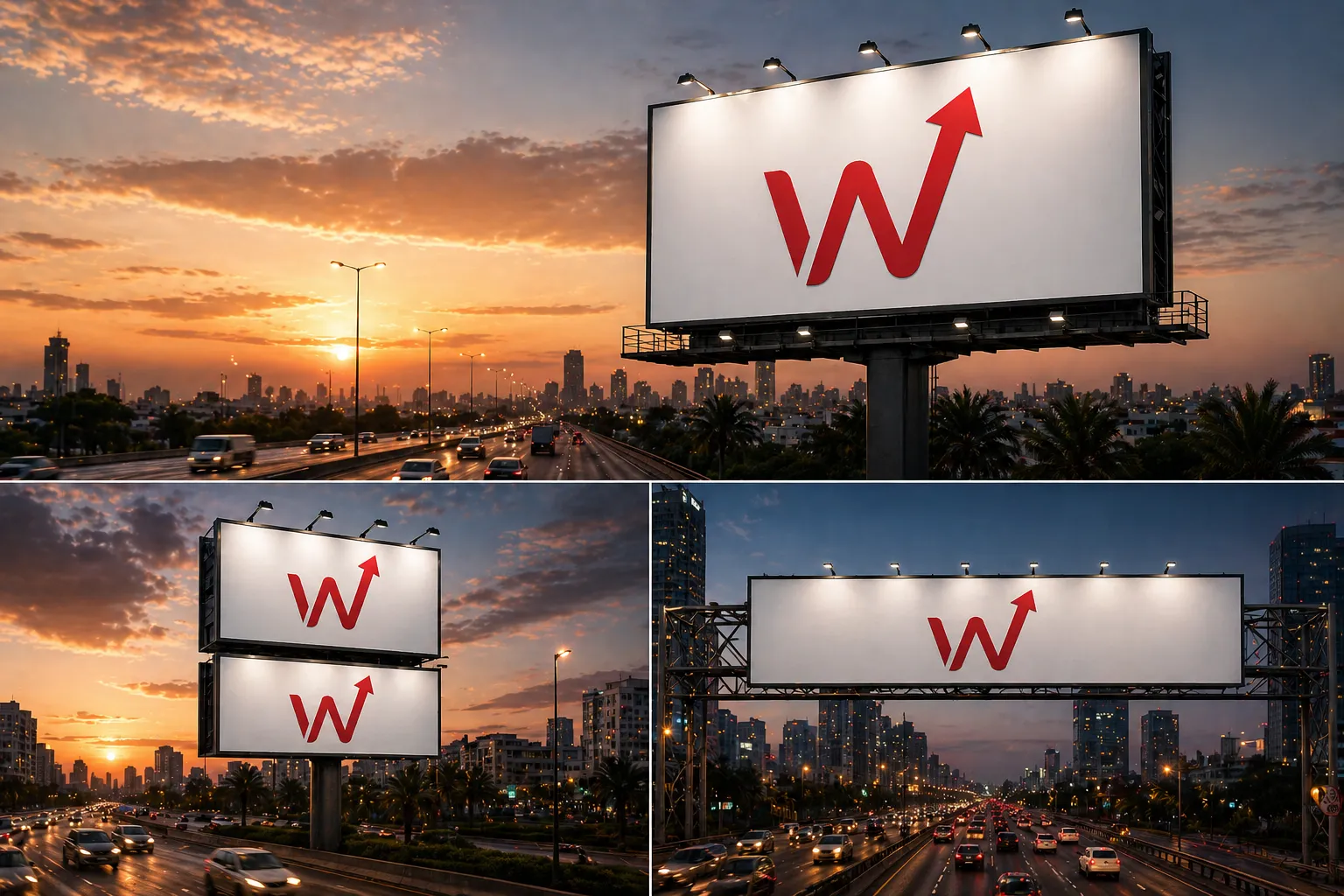
Comparison Table
|
Format |
Height |
Viewing Distance |
Relative Cost |
Best For |
|
Unipole |
20–30m |
500m+ |
Medium to high |
Long-term awareness campaigns |
|
Double Decker |
Medium |
100–200m |
Medium |
Seasonal offers, inner-city streets |
|
Gantry |
Above road |
All lanes |
Highest |
Complete visual dominance |
Road Billboard Prices in Egypt 2026: What to Expect
In road advertising, price isn’t a fixed number; it’s a direct reflection of the location’s value.
Two boards of identical size can differ in price by a factor of three to five because the real difference isn’t in the board itself. It’s in the number of vehicles passing daily, the audience profile, viewing time, and visibility angle.
That’s why a single billboard on the 6th of October Bridge can cost as much as several boards combined on lower-traffic roads.
For a broader understanding of how these channels perform and what drives their impact, you can refer to our complete guide on bridge and highway advertising.
Price Ranges by Format and Location
|
Format |
Location |
Approximate Monthly Price |
Impact Level |
|
Gantry |
Major bridges (October / Ring Road) |
500,000 – 1,000,000 EGP |
⭐⭐⭐⭐⭐ |
|
Unipole |
Highways and major corridors |
300,000 – 600,000 EGP |
⭐⭐⭐⭐ |
|
Bridge Banner |
Inner bridges |
150,000 – 300,000 EGP |
⭐⭐⭐⭐ |
|
T-Pole / Smaller boards |
Secondary/regional roads |
50,000 – 150,000 EGP |
⭐⭐⭐ |
Prices are approximate and vary based on exact location, viewing angle, and lighting.
What Actually Determines the Price
The market doesn’t price billboards arbitrarily. These are the key factors that raise or lower the price:
- Traffic density: More vehicles = higher location value
- Road speed: Congestion = longer viewing time = higher price
- Audience profile: High-end areas like the Suez Road corridor command higher prices
- Viewing angle: Direct face-on positioning = higher price
- LED nighttime lighting: Raises price by 20–30%
- Season: Ramadan and public holidays can raise prices by up to 40%
Market Direction in 2026
The market is clearly moving upward. Prices are projected to rise by 15 to 20%, with stronger demand for premium locations and intensifying competition on major roads. The drivers are growing reliance on outdoor advertising, weakening effectiveness of some digital channels, and the expansion of new cities.
How to Get the Best Value, Not Just Lowest Price
The biggest mistake is choosing the cheapest board. The right move is choosing the best return for the price.
Key strategies: long-term contracts of 3 to 6 months significantly reduce the monthly rate; booking as a package across multiple locations earns higher discounts; and a well-positioned mid-tier location can outperform an expensive one with poor visibility.
How to Combine Road Billboards with Your Digital Campaign to Multiply Results
Road ads alone are powerful. Digital ads alone are effective. But the real strength emerges when both work together.
In 2026, relying on a single channel is no longer sufficient. Success now depends on an omnichannel approach, where the customer sees the same message in multiple places at multiple times.
When a customer sees your ad on the road, then finds the same message on Facebook, Instagram, and Google, what happens is trust reinforcement and an accelerated purchase decision. The outcomes: higher brand recall, greater engagement, faster conversions.
How to Apply the Integration Correctly
Message Consistency: The road ad and the digital ad must carry the same idea, the same identity, and the same offer. The goal is for the customer to recognize you instantly, without having to think.
Geo-fencing: Use targeting tools to reach people who actually pass by your billboard by defining the locations of your boards and targeting the surrounding areas. This can increase conversion rates by up to 22%.
Search Intent: After seeing your ad on the road, customers will typically search for your name on Google. Make sure you appear in search results and support the campaign with Google Ads.
Retargeting: The customer saw your ad but hasn’t decided yet. Retargeting ads showing the same message, or a stronger offer, convert that interest into action.
The Integration Model
|
Stage |
Channel |
Objective |
|
Awareness |
Road billboards |
Build recognition |
|
Interest |
Social media |
Capture attention |
|
Intent |
|
Capture search |
|
Conversion |
Retargeting |
Close the sale |
A Real Example from the Market
A furniture sector client was dealing with weak sales and high Google ad costs despite spending a significant budget. The solution wasn’t increasing the budget; it was redistributing it.
We allocated 40% of the budget to road advertising, booking 3 gantry boards on the Suez Road and in Nasr City. Within 30 days, brand name searches increased by 150%, cost per click dropped noticeably, and lead quality improved.
Frequently Asked Questions
What’s the minimum booking period for a highway billboard?
The minimum is typically one month, but real results start appearing after at least 3 months. Road advertising works through mental repetition, not immediate impact.
Do outdoor companies offer design services?
Yes, professional companies provide a specialized design studio with expertise in road advertising, specifically, to ensure message clarity within seconds, appropriate color choices for visibility, and design compatibility with board dimensions.
Is it better to choose multiple locations or one strong billboard?
In most cases, multiple smart locations outperform a single one. Repetition increases recall, and covering different routes means higher reach. But the decision depends on the campaign objective and budget.
How do I know if an advertising location is genuinely strong?
Ask the company for traffic data, estimated impressions, and photos and videos of the actual location on the ground. Don’t rely solely on descriptions or marketing materials.
Conclusion
Road advertising isn’t just a billboard you hang up; it’s a decision that determines whether your budget translates into real impact or merely fleeting exposure.
In the Egyptian market, the difference isn’t made by the board itself. It’s made by the company you choose, the location where you appear, and the strategy guiding execution. The right choice means genuine reach, repetition that builds trust, and results that can be measured. The wrong choice means an ad that exists, but that no one truly sees.
If you want to invest your budget intelligently in road advertising, start with a clear plan built on data, not guesswork. Get in touch with the WIS Marketing team for a practical overview of the most suitable locations, the right billboard formats, and the best approach to maximize your campaign’s return.