
Every day, companies in Egypt burn through massive advertising budgets without understanding why. Campaigns run, and numbers look decent on paper, but sales don’t move because the agency is measuring success in likes, not revenue.
The Egyptian market in 2026 has no patience for this approach. Customer acquisition costs are rising steadily, competition is intensifying across every sector, and Egyptian consumers have become sharper and harder to convert than they were three years ago. In this reality, choosing the right marketing agency isn’t an operational decision; it’s a strategic one that shapes the entire trajectory of your business.
This article makes no marketing promises. It gives you 8 objective, measurable criteria to evaluate any agency yourself and identify the best marketing partner for real customer growth, based on actual results, not first impressions.
Why Egyptian Companies Waste Millions on the Wrong Marketing
A real estate developer in New Cairo spent over two million Egyptian pounds across six months of continuous ad campaigns. The numbers looked promising: thousands of comments asking for prices, high engagement rates, strong reach. But when we examined the actual results, not a single unit had been sold.
The problem wasn’t the quality of the project. It wasn’t the budget size. It was the metric the agency had built its entire strategy around: reach and engagement instead of purchase intent.
This pattern isn’t an exception in the Egyptian market; it’s become a recurring reality across multiple sectors. When campaigns are built to maximize interaction rather than target serious buyers, your budget becomes a visibility cost, not a growth investment.
What makes this worse is that customer acquisition costs in Egypt have risen by more than 40% in recent years. Egyptian consumers have grown more aware of advertising tactics and have become significantly harder to move from follower to actual buyer.
In this environment, the gap between an agency that operates on numbers and one that operates on impressions isn’t a difference in style; it’s a difference in outcomes.
Why Your Business Needs a Specialized Agency, Not Just an In-House Hire
An in-house employee costs you a salary, benefits, equipment, and office space, and brings a single perspective shaped by their own limited experience.
A specialized marketing agency, by contrast, gives you a complete team: a strategist, a media buyer, a copywriter, and a data analyst, often at the cost of two salaries.
|
Criteria |
In-House Employee |
Specialized Agency |
|
Monthly Cost |
Salary + benefits + tools + office |
Fixed cost equivalent to ~2 salaries |
|
Expertise |
Single perspective |
Multi-disciplinary team |
|
Analytics Tools |
Basic, limited |
Professional tools worth $2,000+/month |
|
Strategic Planning |
Limited to individual experience |
Documented institutional expertise |
|
Market Adaptability |
Slow |
Continuous algorithm and trend monitoring |
Companies that rely on specialized external agencies achieve an average ROI that’s 28% higher than those relying solely on in-house teams.
The reason is what you might call the cross-data advantage; an agency managing advertising budgets across multiple sectors daily already knows what works in your specific market before you spend a single pound.
When does an in-house hire make sense? In-house staff genuinely add value in daily operational tasks: on-site content capture, immediate customer responses, and logistical follow-ups. But strategic planning and managing large ad budgets require institutional expertise and analytical tools that a single employee simply can’t provide.
8 Criteria for Choosing the Best Marketing Agency for Customer Growth
1 — Documented Experience in the Egyptian Market Specifically
The Egyptian market behaves differently from any other market in the region. What works in Dubai or Riyadh may completely fail in Mohandessin or the Fifth Settlement, because Egyptian consumer behavior is shaped by distinct cultural, economic, and social factors.
Egyptian customers prefer direct communication through WhatsApp, and they’re far more influenced by real customer testimonials than by polished creatives. Look for an agency that actively manages local advertising budgets and understands these nuances through experience, not theory.
2 — The Ability to Measure Actual Return on Ad Spend
The right question to ask any agency isn’t “how many followers will you bring me?”, it’s “how many pounds will I earn for every pound I spend?” The metric your decision should be built on is ROAS: return on ad spend.
In the Egyptian real estate sector, a successful ROAS benchmark sits around 12x. If an agency isn’t talking about this metric from the very first meeting, they’re operating under a different logic than results.
3 — A Real Portfolio with Numbers, Not Just Designs
Beautiful, creative, and polished brand identities are not proof of marketing capability. Ask any agency to show you actual dashboards, lead growth curves, and before-and-after sales figures.
A credible agency will clearly show you how it took a client from 100K to 1M in revenue and explain exactly how it got there. Case studies backed by real numbers are the definitive benchmark in this field.
4 — A Strategy Built for Your Sector, Not a Ready-Made Template
Walk away immediately from any agency that offers you fixed packages with a set number of monthly posts. Every sector has a completely different customer journey. A real estate buyer takes an average of 45 days to make a purchase decision; a clothing customer may decide in under 15 minutes.
An agency that understands this difference will build you a custom marketing funnel, from awareness to conversion, not a one-size-fits-all template applied to every client regardless of industry.
5 — Full Transparency in Monthly Reporting
You deserve to know where every pound of your ad budget is going. Monthly reports should include at a minimum: cost per lead (CPL), conversion rate (CR), and individual campaign performance.
More importantly, you should have direct access to the ad accounts themselves. Agencies that hide these accounts from clients are usually hiding performance failures or undisclosed markups along with them.
6 — A Complete Team That Combines Creativity, Performance, and Data
Effective digital marketing in 2026 is not graphic design or page management. It’s an integrated system combining behavioral psychology, data analysis, and advertising technology.
You need a media buyer who understands Meta and Google algorithms in their current state, a copywriter who knows how to write copy that drives decisions, and an SEO specialist who secures your organic presence on page one without depending entirely on paid ads.
7 — Fast Response and Clear Communication
The Egyptian market moves fast. A trend appears and disappears within hours, and marketing opportunities have a narrow window. An agency that takes three days to respond to your questions won’t be able to capture those opportunities when it counts.
What you need is a dedicated account manager who understands your goals and is available specifically when marketing crises hit, because those don’t wait.
8 — A Reputation You Can Actually Verify
Don’t build your decision on what an agency says about itself in a pitch deck. Look at what their actual clients say in Google reviews and LinkedIn recommendations. Even better: reach out directly to one of their past clients and ask whether the agency delivered on what was agreed.
Real reputation in the Egyptian market isn’t built on promises; it’s built on a documented track record of measurable results.
Case Study: How a Struggling Real Estate Developer Became a Sales Machine
Back to the New Cairo developer.
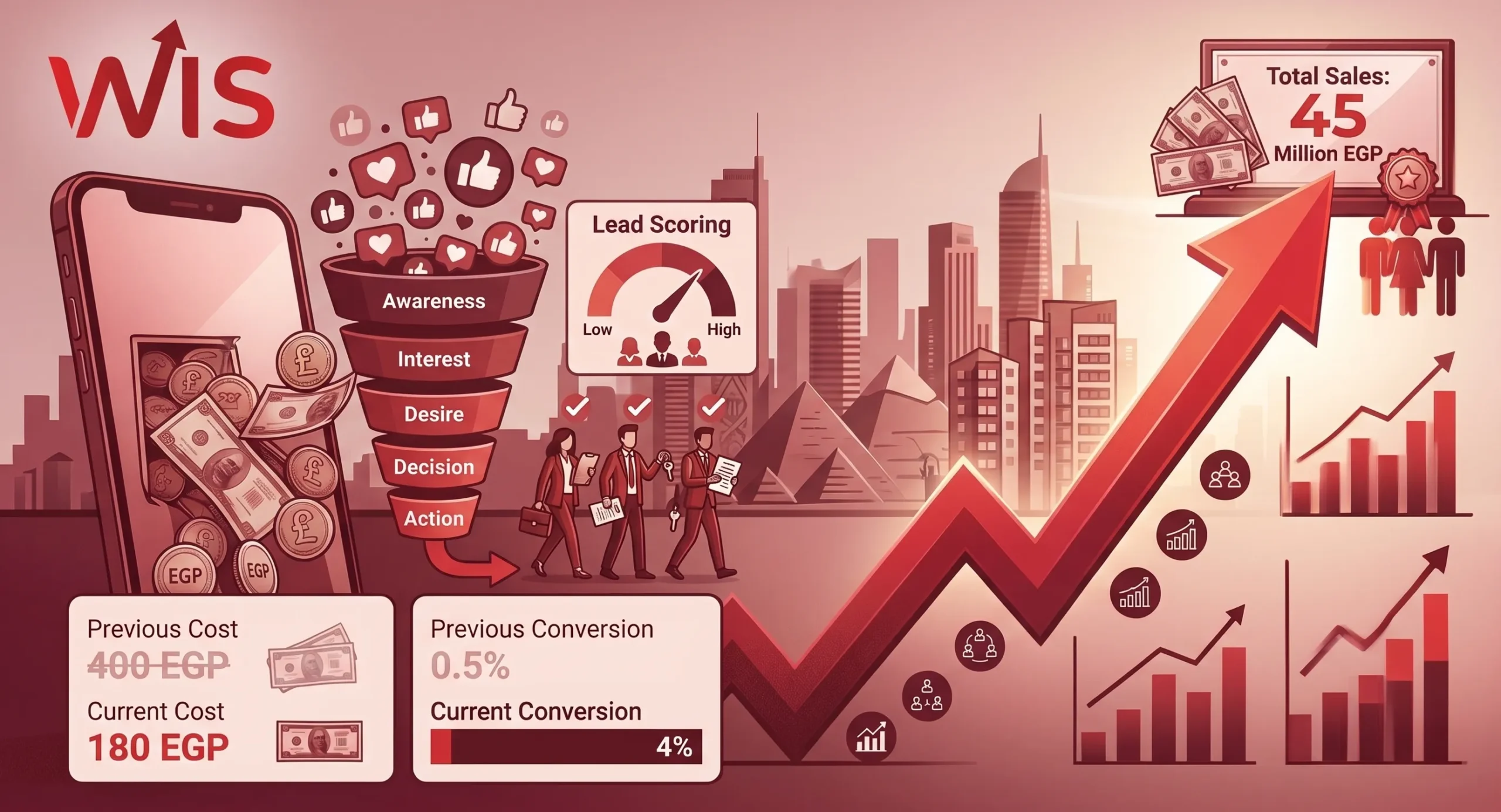
When we started working together, the problem appeared to be a numbers issue on the surface: cost per lead had reached 400 EGP, with a steady flow of inquiries and comments.
But when we analyzed the actual results, it became clear that most of those leads carried no real purchase intent, and the sales team was spending its time chasing unqualified contacts with nothing to show for it.
The issue wasn’t the budget. It wasn’t the project. It was the structure of the marketing strategy itself.
The turning point: from “generating engagement” to “building a sales system.”
We started by redefining the objective. The focus shifted from the number of leads to the quality of leads and their likelihood of converting into actual deals.
The approach was built on three phases:
1 — Rebuilding the marketing funnel. The customer journey was mapped into clear stages from awareness to purchase, with ad messaging tailored to each stage, instead of one generic message pushed to a broad audience.
2 — Implementing a lead scoring system. A system was introduced to evaluate lead quality based on behavior and data, filtering out unserious inquiries before they ever reached the sales team, reducing wasted time and resources.
3 — Targeting purchase intent. Instead of targeting a broad audience generally interested in real estate, we focused on specific segments showing clear signals of imminent purchase decisions, using advanced behavioral and analytical data.
Results within 90 days:
- Cost per lead dropped from 400 EGP to 180 EGP
- Sales closing rate rose from 0.5% to 4%
- Measurable improvement in inbound lead quality
- Sales team efficiency increased significantly with fewer unqualified contacts
Final result: 45 million EGP in sales achieved within 8 months.
What these numbers actually reflect isn’t just a successful campaign; it’s a shift in thinking:
- From chasing reach → to chasing return
- From collecting data → to filtering qualified buyers
- From running ads → to building an integrated sales system
This is the real difference between an agency that manages campaigns and one that builds sustainable, number-driven growth.
Common Mistakes When Choosing a Marketing Agency
1 — Choosing Based on the Lowest Price
A low price in marketing almost always means a higher cost down the line. An agency charging minimal fees won’t give you an expert spending real time analyzing and managing your account; it will rely on juniors managing multiple accounts simultaneously with no real depth of performance.
You’re not saving money. You’re paying your ad budget as tuition for an unqualified team.
2 — Not Setting Clear KPIs from the Start
Any campaign without defined performance indicators is impossible to measure and therefore impossible to improve. There needs to be explicit agreement from day one on what’s being tracked: number of leads, calls, direct sales, or ROAS. Without this clarity, different interpretations of results are inevitable, and disputes between the company and the agency almost always follow.
3 — Trusting Promises Without Evidence
Any agency guaranteeing instant results or inflated numbers in a short timeframe is operating outside the logic of real marketing. No credible agency can guarantee a first-page Google ranking within days or a specific number of sales in record time without testing and analysis.
Digital marketing is a process of continuous experimentation and data-driven improvement, not promises.
How to Measure Your Agency’s Success After 90 Days
After the first 90 days, the real performance picture should start to emerge. This period isn’t enough for a final verdict, but it’s enough to assess the direction: is the campaign improving, or is it burning budget?
The core metrics to track:
- CPL (Cost Per Lead): Is it declining over time?
- ROAS (Return on Ad Spend): Is the campaign generating a clear return on what’s being spent?
- Organic Growth: Are your search rankings improving?
If none of these show positive movement after 90 days, the problem is in the strategy, not just the execution.
What your first monthly report must include:
- Reach & Impressions: to verify the campaign is reaching the intended audience at a sufficient scale
- CTR (Click-Through Rate): a direct signal of ad content quality; higher CTR means the message resonates
- Conversion Rate: reveals how effectively the landing page or website turns visitors into leads or buyers
- CPL (Cost Per Lead): the most critical metric in lead generation campaigns, directly linking spend to outcome
WIS Marketing: How to Grow Your Customer Base in the Egyptian Market
After covering the criteria and common mistakes, the most important question remains: how do these principles translate into actual results on the ground?
The WIS Methodology: Data First, Always
At WIS, decisions aren’t made on instinct or guesswork; they’re built on precise data analysis.
The process starts with a deep understanding of the market you operate in:
- Analyzing your real competitors, not just the obvious ones
- Identifying the marketing gaps your business can actually exploit
- Studying customer behavior with a focus on purchase intent signals
From there, a tailored marketing strategy is built, one centered on direct conversion, not just reach or engagement. We use advanced analytics tools and AI-driven technology to read user behavior and make decisions based on data-backed projections, not assumptions.
Why Do Growth-Focused Companies Choose WIS?
Because they’re looking for a partner who understands how data becomes decisions, how campaigns become sales, and how marketing becomes a sustainable growth system.
The difference isn’t in running ads. It’s in building an integrated system that connects targeting, content, and conversion into one cohesive engine.
Ready to Start Attracting Customers Consistently?
Choosing the right marketing agency isn’t a simple operational decision; it directly affects your company’s growth, your sales stability, and your ability to compete in a market that never stops changing.
The gap between an agency that delivers results and one that drains your budget doesn’t show up on day one. It shows up clearly in the numbers for a few months.
If you’re looking for real growth built on clear metrics, the first step isn’t increasing your budget; it’s improving how you manage it.
Get in touch with WIS Marketing for a comprehensive analysis of your current situation and an actionable plan built on real market data, designed to grow your customer base in a way you can actually measure.